

Kayrouz & Associates went from 69 website visits a month to more than 4,000. Heads of legal at international groups now find the firm on Google and in ChatGPT, and a practice that grew on referrals for nineteen years now signs new clients through its website.
- Client: Kayrouz & Associates, a corporate and commercial law firm with offices in Dubai, Abu Dhabi, Sharjah and Beirut
- Market: the UAE, with Arabic and Russian speaking audiences across the GCC and CIS
- What we did: brand, website, SEO, content strategy, legal content in three languages, technical SEO and lead triage
- Timeline: July 2025 to today, with twelve months measured
- Paid media: none, with every lead coming from organic search and AI assistants
The results in twelve months
In the first month of the project, 69 people visited the firm's website. Twelve months later more than 4,000 visit each month, and the firm now wins more new clients from search than from any source except referrals.
- 995 enquiries through the website, more than 800 of them qualified leads from companies, founders and investors.
- 125 commercial keywords that we moved from page three into Google's top three.
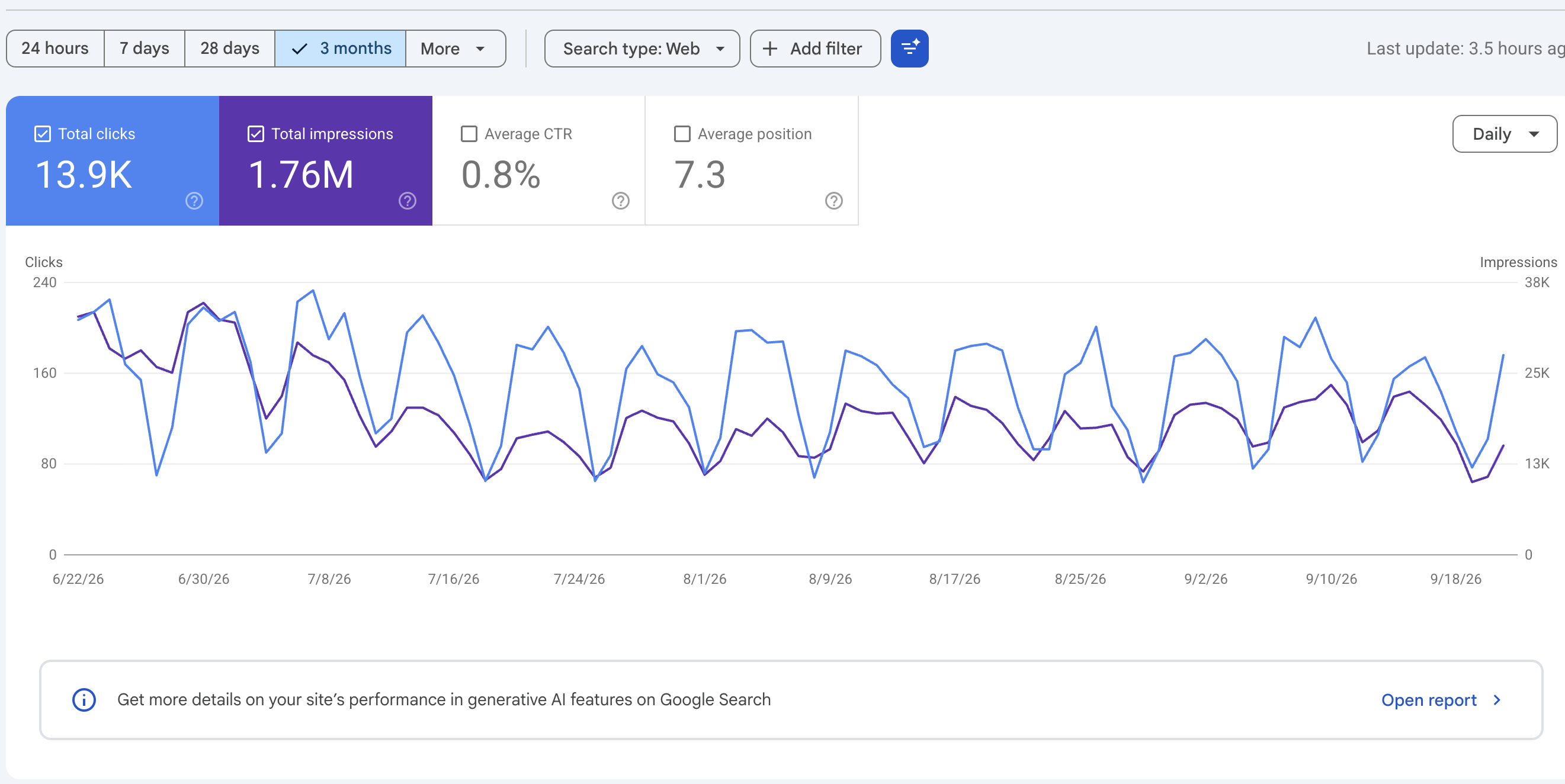
- 26,800 clicks and 5 million impressions from Google Search in the first year.
- 52 editorial backlinks from sites with real traffic, including Wikipedia and a Dubai free zone, which the firm earned without a single outreach email.
- Six-figure signed fees from website enquiries, ranging from monthly retainers to a multi-million dirham commercial fraud case.
- One in ten new engagements the firm signs now starts on its website.
[Screenshot: Google Search Console, performance over 12 months, clicks and impressions]
A referral practice that wanted a second source of clients
Kayrouz & Associates opened in 2006 and spent nearly two decades building a corporate and commercial practice on referrals. Referred clients are often the best a firm gets, but you can only grow as fast as your network, and a foreign company that has never heard your name will not find you through a friend.
The management wanted inbound enquiries from businesses that needed a UAE lawyer and had not yet chosen one. They did not want to rent that demand through Google Ads, where firms pay some of the region's highest prices per click and lose the leads the day they stop paying.
We took on the brand, the website and the content, and agreed one measure of success with the management at the start. We would judge the project by enquiries from clients worth having.
Where Dubai law firms waste their marketing budget
Most law firms in the UAE compete for the same handful of searches, such as "lawyers in Dubai", "real estate lawyers Dubai" and "best commercial lawyers Dubai". These keywords carry volume and clear commercial intent, and they are the hardest ground in the market.
Directories and firms with aged domains and hundreds of referring sites hold the first page for those terms. A firm starting from zero will not outrank them in year one, however good its website looks, and paying to appear above them works for as long as you keep paying.
A person who searches "lawyers in Dubai" is often browsing. They may be months away from hiring anyone, and they will compare you with ten other firms on price. A firm that sells expertise gets little back from that audience.
[Screenshot: Ahrefs keyword difficulty and top-ranking domains for "lawyers in Dubai"]
We targeted the question a general counsel types before a deadline
We went after a different client, the general counsel who types an exact legal question into Google three days before a deadline.
The search "how to terminate a commercial agency in the UAE" gets a fraction of the volume of "lawyers in Dubai". The person behind it has a live problem, a contract on the desk and a decision to make this week. When they find a clear answer from a firm that handles this kind of matter, they fill in the contact form.
The firm won a high-value overseas client from that one article. We repeated the pattern across a few hundred precise questions in nine practice areas, and the firm now appears in front of people at the moment they need a lawyer and are ready to instruct one.
You win a head keyword with budget. You win the exact question a general counsel asks with content, and few law firms in Dubai write that content.
Step one was rebuilding the website around the work the firm wants
Before we wrote a single article, we rebuilt the website around practice area hubs. We built each hub as a commercial page in its own right. It targets a cluster of mid-tail searches, sets out the firm's services in that area and lists the lawyers who handle those matters.
The construction law hub, for example, covers searches such as "construction lawyers Dubai", "construction disputes", "FIDIC claims" and "decennial liability", and names the lawyers who run those cases. We built industry hubs for energy, real estate and financial services on the same model, for clients who search by their business rather than by their legal problem.
We rebuilt every lawyer profile with consistent credentials, practice areas and languages, and added Organization and Person schema across the site and the firm's Google Business Profile. Clients will not notice this work on the finished site, and it carries more weight than most of what they do notice. Google and AI assistants now hold a clear and consistent record of who these lawyers are and what they do, and that record is a large part of why Google trusts the firm with legal queries.
[Screenshot: a practice area hub page, services and lawyer cards visible]
Step two was 240 articles written with the lawyers who do the work
Around those hubs we published more than 240 expert articles. Each one answers one question a business client is likely to ask: how to structure a DIFC holding company, when an ESOP triggers tax, what a FIDIC claim notice must contain, how the UAE enforces a foreign arbitral award.
We ran every topic through three filters before we wrote it. The reader had to be a business with a real matter rather than an individual looking for free advice. The topic had to lead to work the firm wants, ideally a retainer. And the site could not already cover it, so we checked each new idea against the full library to stop two articles competing for the same search.
We shaped each article with the lawyer who handles that type of matter and wrote it to a strict house style: plain British English, one idea per sentence, every rule tied to a named law and a date, and no filler. We wanted content a general counsel could forward to colleagues and an AI assistant could quote as a reliable source.
Every article links back to its practice area or industry hub. Each new piece adds authority to the handful of pages that win the work, instead of spreading it across hundreds of posts.

Step three was publishing in English, Arabic and Russian
Expatriate founders, regional family groups and foreign investors make up much of the UAE market, and many of them search in their own language. We translated the full library into Arabic and Russian through a pipeline that keeps legal terminology consistent and preserves every link and heading across all three versions.
The firm now holds three sites' worth of expert content under one domain. An Arabic-speaking family business in Sharjah and a Russian-speaking investor structuring a Dubai holding company both find the same firm, in the language they think in.
[Screenshot: the same article in English, Arabic and Russian side by side]
Step four was preparing the firm for AI search
Clients now ask ChatGPT, Perplexity and Google's AI Overviews which firm to use, and those tools recommend firms they can understand and trust.
The work that ranks on Google also earns citations in AI answers. Clear structure, named authors, schema and direct answers to specific questions make the firm easy for an AI assistant to quote. Twelve months in, AI assistants account for more than 3% of the firm's website sessions, visitors from them engage well above the site average, and several clients found the firm through ChatGPT before they sent an enquiry.
[Screenshot: GA4 traffic sources, showing ChatGPT and Perplexity referrals]
The links came to us
We sent no pitch emails and paid for no placements. The firm still earned 52 backlinks from domains with a Domain Rating above 25 and real traffic, because other writers found the articles useful enough to cite.
Wikipedia's page on Abu Dhabi Global Market cites a Kayrouz article on regulatory sandboxes in the DIFC and ADGM. Meydan Free Zone's official blog cites the firm's article on non-compete clauses in the UAE. A global mobility company referenced its analysis of the 2026 UAE tax changes in a guide for HR managers relocating staff to Dubai, and a UAE logistics company linked to its guide on setting up a logistics business.
Over the year the firm's Domain Rating rose and its count of referring domains came close to doubling. For a law firm, a free zone or an encyclopaedia citing your analysis counts as proof of expertise in its own right.
[Screenshot: the Wikipedia ADGM page with the Kayrouz citation highlighted]
[Screenshot: Ahrefs referring domains growth over 12 months]
Who got in touch
Traffic has value when the right people arrive. Over twelve months the firm received 995 enquiries through its website across all nine practice areas, and more than 800 of them came from companies, founders and investors with a genuine legal need.
The strongest leads followed one pattern. The person had a specific problem, found the article that answered it and got in touch already convinced that the firm understood their situation. A few examples:
- The head of legal at a German pharmaceutical group with over €500 million in revenue asked the firm to review a UAE distribution agreement after reading one article.
- A Japanese trading house requested a meeting on carbon credit regulation in Abu Dhabi.
- The legal team of a global e-commerce group sought advice on UAE payment services rules.
- A construction company asked for a legal review of a major contract after reading the firm's FIDIC content.
Alongside them the firm received a steady flow of shareholder agreements, DIFC and free zone structuring, ESOP schemes, M&A documentation for corporate groups, RERA disputes and commercial litigation. The firm turned several of these enquiries into retainer clients, and the retainers alone have paid for the marketing engagement many times over.
[Screenshot: an anonymised inbound enquiry from a head of legal]
What steady SEO growth for a law firm looks like
Search Console shows a slow, even climb from almost nothing in mid-2025 to a stable plateau by mid-2026, with an average position of 7.9 across more than 5 million impressions. Organic search now accounts for over half of all sessions and stands as the firm's largest traffic channel.
Content for a law firm compounds over months, so treat any agency that promises a dramatic graph after three months with suspicion. We saw the first enquiry worth talking about after several months of work. From there each new article added to the pipeline, and the results have held with no paid spend behind them.
[Screenshot: GA4 sessions by channel, organic search first]
Is this approach right for your law firm?
This kind of programme suits firms that sell expertise to businesses, such as corporate and commercial practices, disputes and arbitration teams, and construction, finance and regulatory specialists. It fits firms that want higher-value work rather than more calls about parking fines.
It also asks something of the firm. The lawyers need to share how they think about their matters, on a regular basis, for a year or more. Their input makes the content credible, and no agency can fake it. In return, the firm owns an asset that keeps working in three languages, on Google and inside AI assistants.
If you need a full pipeline next quarter, paid search will get you there faster. If you want inbound work that grows every month and continues after the budget stops, invest in expert content.
Frequently asked questions about law firm SEO in Dubai
How long does SEO take for a law firm in the UAE?
Expect the first meaningful enquiries within six to nine months, depending on your starting point. Long-tail legal questions rank sooner than competitive terms such as "lawyers in Dubai", so we build the long-tail content first.
Is SEO better than Google Ads for a law firm?
They do different jobs. Ads buy visibility today and stop when you stop paying. SEO builds visibility that compounds. Kayrouz & Associates ran no paid campaigns during this project, and every lead came from organic search and AI assistants.
Do you write the legal content yourselves?
We research, structure and write every article, and we shape each one with the lawyer who handles that type of matter. The firm keeps full control over its positions, and its lawyers spend minutes on each piece rather than hours.
Can a law firm appear in ChatGPT answers?
Yes. AI assistants recommend firms whose content they can read, trust and quote. Structured, expert articles with named authors and proper schema give you the best chance of earning those mentions.
Do you only work with law firms in Dubai?
We work with law firms and professional services firms across the UAE and the wider GCC, and with international firms that want to win clients in the region.
Talk to us about your firm
Sparqs builds SEO and content programmes for law firms and professional services firms in the UAE. If your pipeline still depends on referrals, we will show you which questions your future clients already ask and how much of that demand your firm could win. Let's talk.